

Q4 2025 Dispatch
Welcome to the second quarterly dispatch. This update builds on top of what was briefly shared in the previous dispatch and the transition from Unreal Engine to a web-based MVP in order to expedite development. I will focus on the effort that went into building the Web MVP, where it currently is, and where it’s headed in Q1 and beyond in 2026.
Q4 at a glance
-
Company: No major operational changes this quarter; focus remained on product execution.
-
Websites: No major site changes; cadence remains focused on quarterly dispatches.
-
Community: No major updates; broader outreach is timed for when the build is more presentable.
-
Production: Major Web MVP integration: governance, economic spine, class response, and early preview legibility.
-
Direction: Continued commitment to Web MVP as the fastest path to validated systems and a de-risked production foundation.
The Quarter In Reflection
The goal was simple: I needed to build my own version of a chess board, and the guiding principles focused on building a visually minimal experience that heavily focused on an underlying system that interacted with other systems coherently.
In the early stages of development, many systems existed as isolated proofs. They worked, but they didn’t yet form a strategic loop. The core work of Q4 was connecting those pieces so the city can be understood as one organism where population behavior, neighborhood pressure, market influence, and early policy decisions fed into shared outcomes.
By the end of the quarter, the board was closer to that goal and had governance levers that touched the city’s social fabric, an economy loop that fed into visible coverage and pressure, and the UI was increasingly designed to tell the truth about what’s happening. Getting the board to a place where iteration starts revealing truth instead of just producing “it seems fine” results was the real de-risking step for Q4. It’s still early, but the loop is there to push against now.
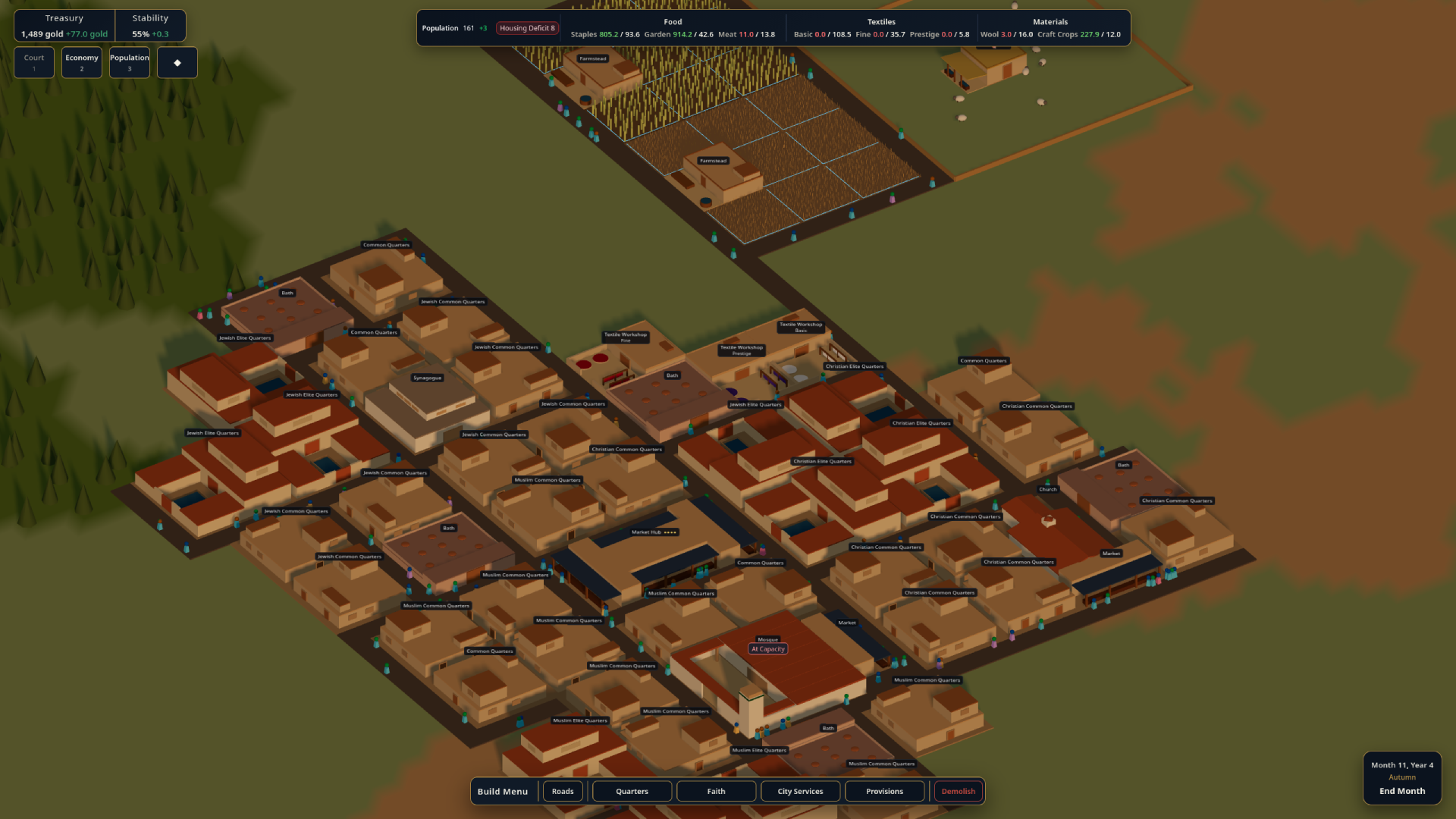
City overview showing the multi-faith core of the city, with baths, markets, workshops and farmland at the edge. Families are already moving through this layout and claiming quarters, even though the visuals are intentionally minimal and still at a placeholder level.
The Spine Comes Online
The work in September put the board on the table. There was a working grid, construction, camera controls, and a simple time system that advanced the city in monthly steps. It’s worth mentioning that transitioning from real-time to a monthly turn-based approach was a calculated MVP development decision because it simplified how the system works and how it can be validated.
With the initial foundations built, Q4 was about giving that board a living cast. Buildings needed to mean something. People needed to move in, react and push back. That started with households, faith and class. Families now have a place to live, a religion, a social class and a basic set of expectations, and they don’t just sit inside colored blocks. In the current slice, they already respond to the presence or absence of anchors like religious buildings and baths (Hammams), and they feel the pull of markets and basic services when those are nearby.
The city is starting to behave more like a social organism than a static layout. Pressure can build where services are thin or where communities feel boxed in, and early versions of that pressure already show up in how households are scored and how comfortable a neighborhood feels. A lot of this is still a first pass, but the wiring is there and it’s being exercised.
Governance Becomes Real
Governance in The Vizier is not meant to be decoration. It is the way the player answers the city when it starts to lean out of balance. If the population is strained, if certain groups feel ignored or overburdened, there has to be a way to respond that is more serious than dropping another building on the map.
Q4 brought the first version of those levers into the Web MVP. The city now reacts in simple but real ways when you raise or relax pressure across different groups. Choices about how hard you lean on revenue, how generous or cautious you are with public support and how you treat different parts of the city already feed back into approval, basic comfort and the treasury.
It’s still narrow and early, but it’s grounded. Decisions now sit inside the same loop as population behavior and neighborhood pressure, even if the reactions are not as sharp or legible as they need to be yet. Tuning those responses is a big piece of the Q1 work.
Economic Spine
If governance is how you steer the city, the economic spine is what the city runs on. For this project that was never going to be an abstract bar that simply grows over time. It needed some connection to how people actually lived, without turning into a heavy logistics game.
Q4 focused on putting that base in place. The Web MVP now has a simple but believable mix of production that reflects the setting. Crop fields and basic livestock are in, along with early workshops that turn raw materials into usable goods. These flows are intentionally straightforward for now. They’re built to be understood and tuned, not to hide complexity for its own sake.
Markets sit on top of that production and shape who actually feels supplied. In this slice, food and basic goods are still mostly numbers in tables, but they are starting to appear as coverage patterns on the map rather than a single stockpile bar. You can already see the outlines of where the city is eating well and where it is on the edge, even though the visualization and balance are going to keep changing through Q1 and beyond.
This is the backbone the later fiscal and trade work will rest on. Before talking about routes, tolls or anything more advanced, the local economy needed to be able to stand on its own.
Readability
Making systems interact is one part of the job. Making them understandable is the harder part, and Q4 forced a lot of that work to happen.
Most of the information in a game like this lives in the interface. That meant the HUD, quarter cards, markets and economy views had to start carrying real weight. They went through several iterations this quarter. Layouts were reworked, labels were rewritten and entire panels were reshaped to at least answer a basic question: when something changes in the city, can I see it and take a first guess at why it happened.
More than once, the UI work pushed back on the simulation itself. If a mechanic could not be explained cleanly without turning a panel into a wall of numbers, it was either simplified or tied more directly to something visible on the map. That feedback loop is still rough, but it’s now part of how I work. The design is not just about what is possible. It is about what can eventually be read.
The result is not final and it will keep evolving, but the direction is clear. The Web MVP is moving toward a state where a screenshot, a short video or a brief play session needs less and less explanation on the side. It’s not at that point yet, but Q4 moved it closer.
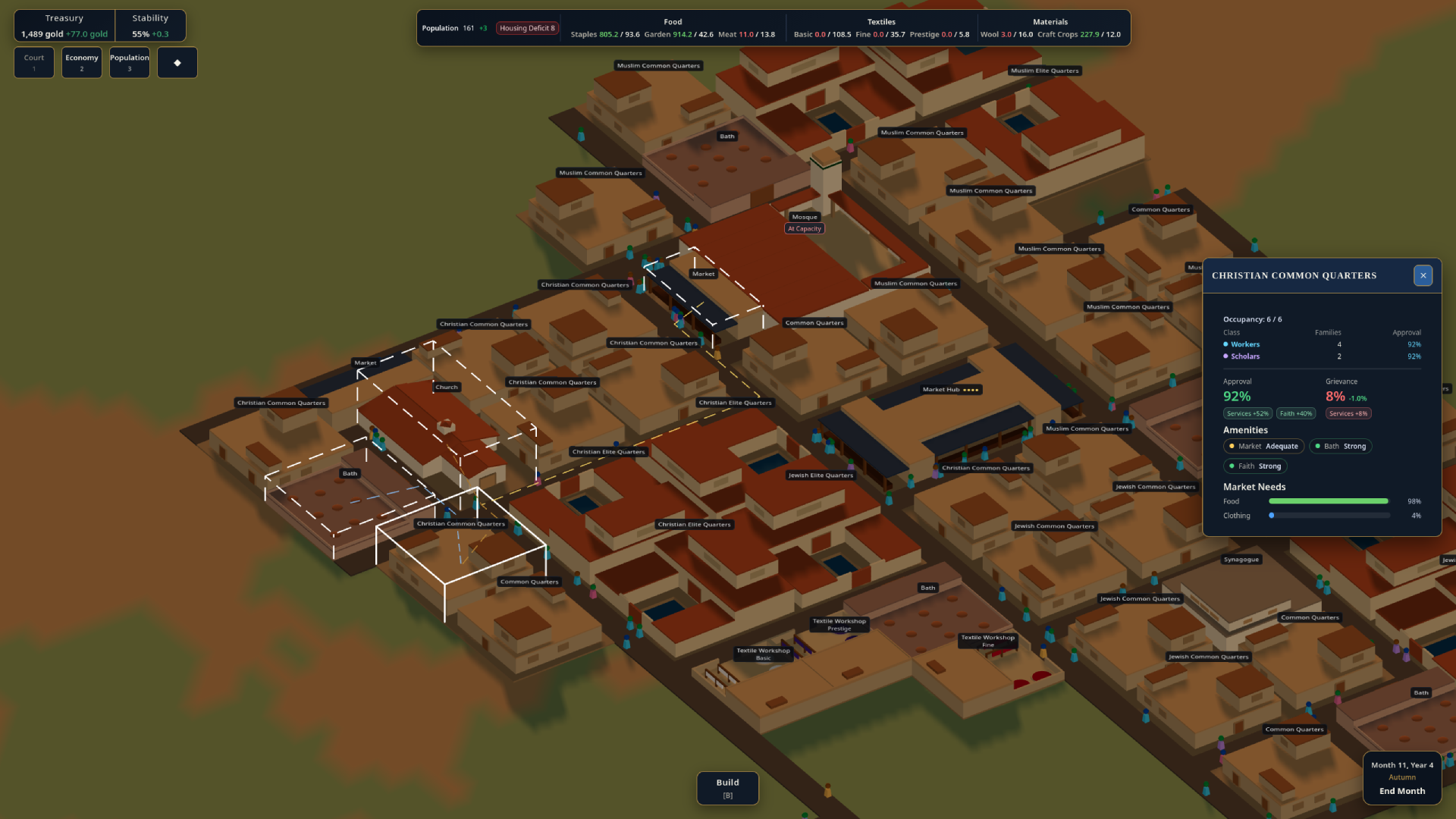
Quarter close-up: Christian common quarters outlined in white. Dashed borders mark the bath, church and nearby market that serve them, while the lines show the routes households take between home and those anchors. The panel on the right summarizes who lives there, how they feel, and which needs are currently being met.
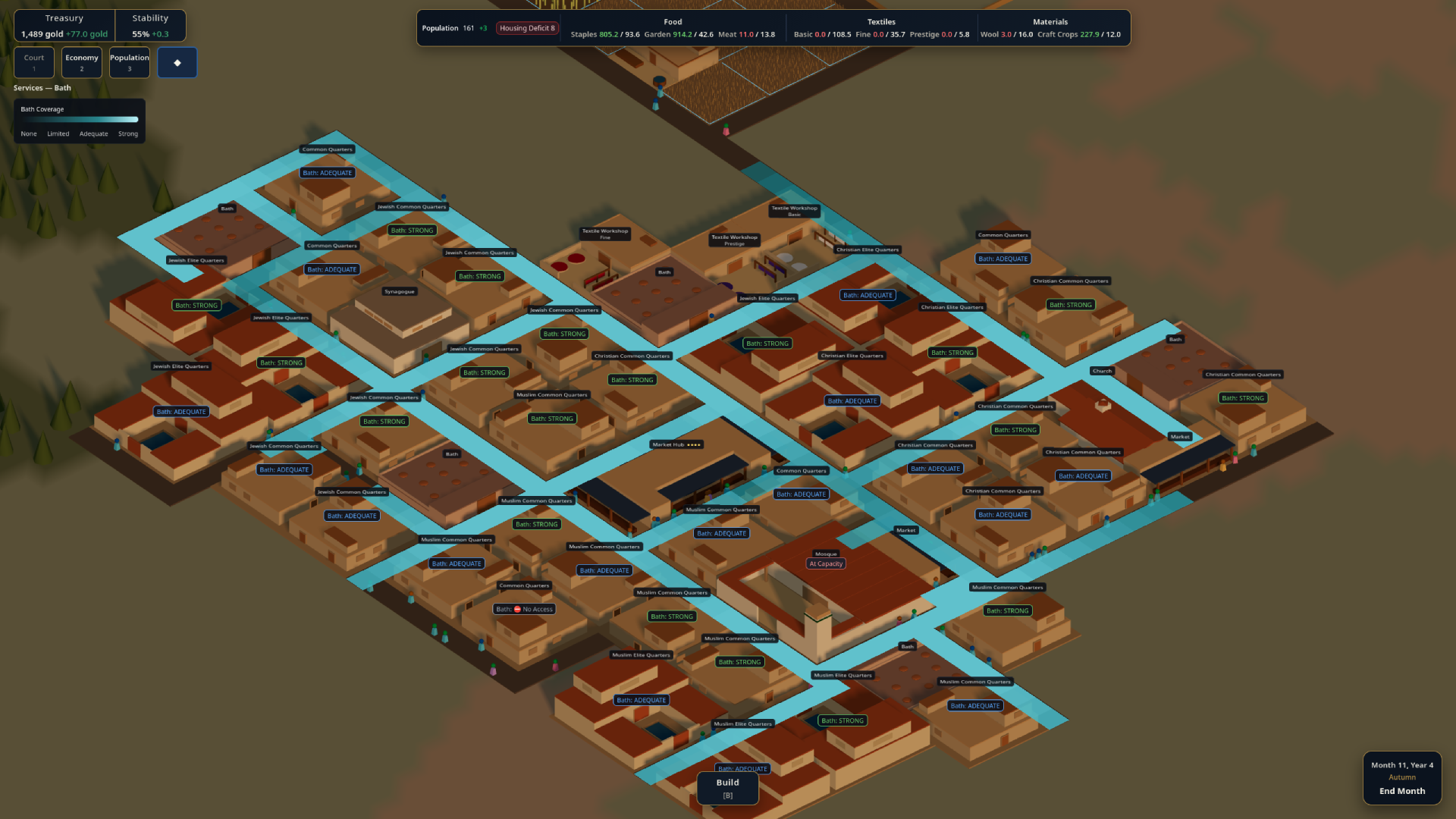
Bath coverage overlay: cyan routes mark where households have access to a bath and how strong that access is, from “no access” through “adequate” to “strong”. This is one of several overlays used to turn raw simulation into something you can read at a glance.
Measuring The Work
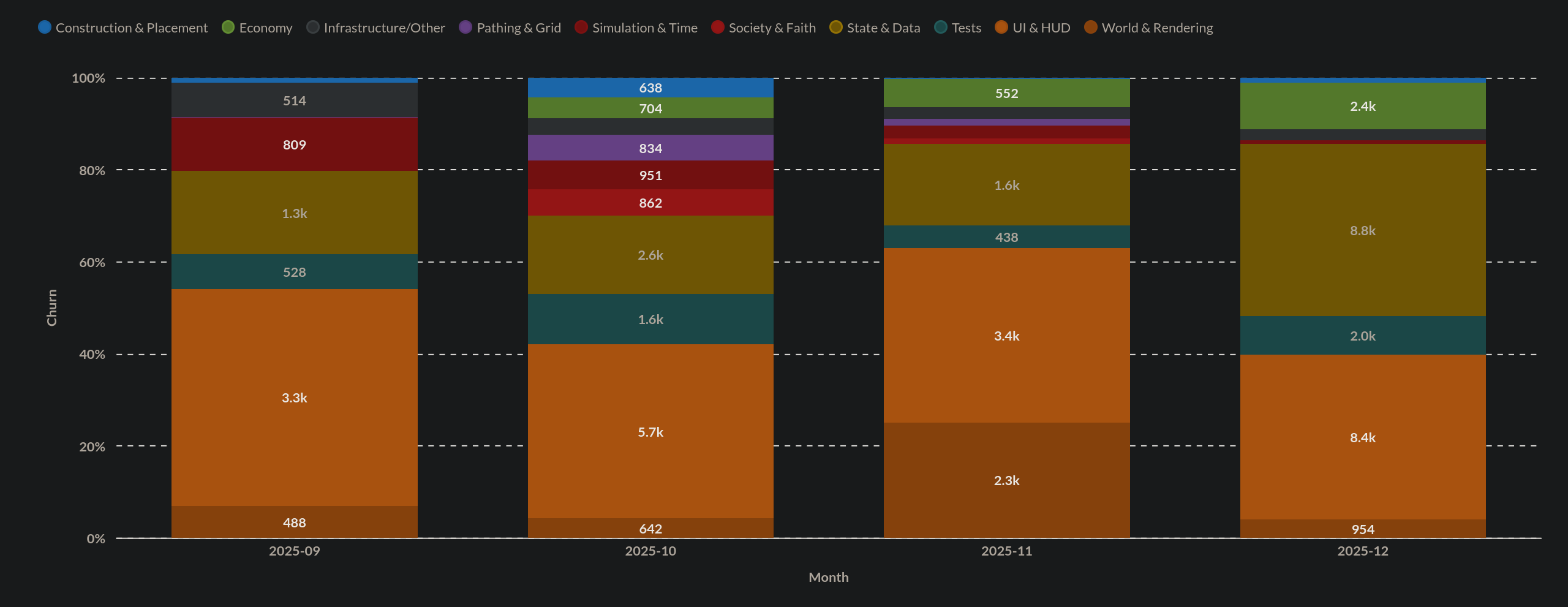
This chart is a snapshot of where the work actually moved between September and December. Each bar is a month. Each colored band is one of the core runtime areas in the Web MVP (UI & HUD, State & Data, World & Rendering, Economy, Simulation & Time, Pathing & Grid, Tests, plus a small Infrastructure/Other bucket). The values shown are code churn: lines of code (LoC) added plus lines removed on the main branch.
Churn doesn’t measure “quality”, “progress”, or “size”. It measures change for which systems were actively built, refactored, or consolidated. The goal isn’t to treat LoC as a KPI. The goal is to make invisible work legible, especially in a quarter where much of the value came from integration and rewiring rather than flashy new surface features. Design docs, specs, tooling, and analytics are intentionally excluded here to keep the picture focused on runtime game code.
Looking ahead
With 2026 already underway, my priority is to keep pushing the Web MVP toward a slice that feels solid under pressure. A lot of what I described above is still a first pass. Q1 is about making those loops less brittle and more honest. With the foundations in place, the next step is to tighten how the city reacts, how strain and comfort show up and how the different systems line up behind a single version of the truth.
That means continuing to refine the simulation model and the core formulas that drive population response, approval and basic economics. It also means bringing the first layer of narrative and characters into this slice so the vizier role is not just implied, it is felt in moment to moment decisions. Alongside that, I will keep building out the economic side in a way that gives players more tools without drowning them in complexity.
In parallel, I will be preparing the Web MVP for closed, invite only testing sessions. The aim is straightforward which is to have a build that friends, early supporters and investors can play on their own time and come away with a clear sense of what The Vizier is trying to do.
Closing
Solo development of a project with this level of complexity, even in a scaled-down form, is not easy. I’ve hit plenty of walls, and the struggle was and continues to be very real.
I believe in this project because it’s an attempt to treat strategy games as a way to think seriously about power, faith and everyday life, and to handle religious, political and cultural topics with more nuance than they usually get. The world feels increasingly fractured and The Vizier is my attempt to build something that sits with that complexity instead of looking away. Seeing those ideas slowly take shape on screen is what makes it possible to keep going.
I’d also be remiss not to acknowledge my close friends and the allies I’ve crossed paths with online who believed in me and in this vision. Their questions, encouragement and patience have made the journey easier and sharper.
If you’d like to help, you can join the Discord server, share this dispatch with anyone who might be excited about The Vizier, and, when the time comes, take part in early tests. Interest and honest feedback from players will be a big part of convincing partners and investors that this project deserves to exist.
Thank you for following along and for reading the second quarterly dispatch.
Sincerely,
Mohammad
Links: Founder LinkedIn | Mizan Interactive LinkedIn | The Vizier | Community Discord